
Systems & Processes
Build a more consistent, efficient and profitable shop by creating better ways to get the work done.
When your shop is busy, it’s easy to assume business is good.
But being busy doesn’t always mean you’re operating efficiently—or profitably.
Cars waiting for approvals. Technicians waiting for parts or information. Customers who don’t get called back. Recommended work that never gets followed up on. Jobs that take longer than they should. Tasks that get done differently depending on who’s working that day.
Individually, these may seem like small problems.
Together, they can cost you time, productivity, customers and profit.
Systems & Processes is practical training designed to help you identify where your shop is losing time and opportunities, create more consistent ways of working, and build systems your team can actually follow.
Stop Relying on Memory and Good Intentions
If an important task gets done only because someone remembers to do it, you don’t really have a process.
The same is true when only one person knows how something works—or when every employee has a different way of doing it.
Good systems take important activities out of people’s heads and turn them into clear, repeatable processes.
That doesn’t mean creating a giant operations manual nobody reads.
It means making it easier for your people to know what needs to happen, who is responsible and what happens next.
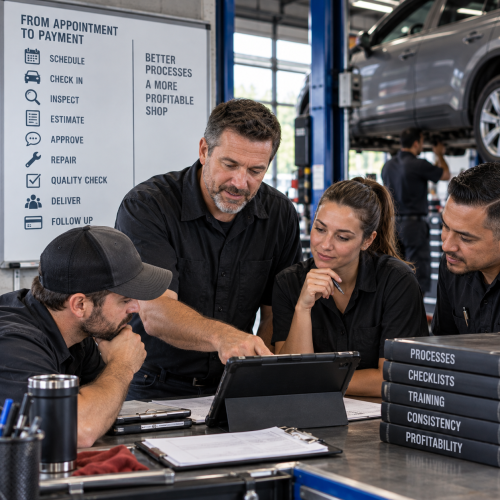
Look at What Happens From Appointment to Payment
Some of your biggest opportunities may be hiding in the everyday flow of a repair order.
How is an appointment scheduled?
What information is collected before the vehicle arrives?
How quickly does the vehicle move from check-in to inspection?
How are inspection findings communicated?
Who follows up when a customer hasn’t approved the work?
How are parts ordered and staged?
How does the technician know what’s been authorized?
When and how is the customer updated?
What happens to recommended work the customer declines today?
A better process at each step can help work move through your shop more efficiently—and help prevent revenue opportunities from slipping through the cracks.
Keep Your Technicians Working on Cars
Your technicians are most valuable when they’re doing skilled work.
Every minute they spend waiting for a vehicle, looking for information, tracking down parts, clarifying an estimate or figuring out what to do next affects productivity.
We’ll look at the processes surrounding your technicians—not just what happens in the bay—to identify ways to reduce unnecessary delays and keep work moving.
Sometimes improving technician productivity has less to do with asking technicians to work faster and more to do with removing the things that slow them down.
Create a Consistent Inspection and Approval Process
A great inspection doesn’t create value if the information never reaches the customer effectively.
Your process should make it easy to document what the vehicle needs, prioritize recommendations, communicate them clearly and give the customer the information needed to make a decision.
Consistency here can improve the customer experience while helping your shop capture more of the legitimate work already coming through your doors.
The goal isn’t to sell customers things they don’t need.
It’s to make sure needed work isn’t lost because your process broke down.
Don’t Let Declined Work Disappear
A customer may say no to a repair today for dozens of reasons.
That doesn’t mean the vehicle no longer needs it.
Without a follow-up system, those recommendations can disappear into an old repair order until the customer has a breakdown—or has the work done somewhere else.
You’ll learn how to create a consistent process for documenting, prioritizing and following up on declined and deferred work so customers aren’t forgotten.
Reduce Mistakes, Rework and Comebacks
Mistakes cost more than the time required to fix them.
They interrupt the schedule, consume technician time, create additional parts costs, frustrate customers and can damage trust.
Clear procedures, quality-control checkpoints and defined responsibilities can help prevent avoidable errors before the vehicle leaves your shop.
Doing the job right the first time is both a customer-service strategy and a profitability strategy.
Make Sure Everyone Knows Who Owns What
When responsibility isn’t clear, tasks either get duplicated or don’t get done at all.
Who orders the parts?
Who contacts the customer?
Who checks that the vehicle is ready?
Who follows up on declined work?
Who handles a comeback?
Who makes the decision when the owner isn’t there?
Good systems create ownership.
Your team should know not only what needs to happen, but who is responsible for making sure it happens.
Measure What Matters
You can’t improve a process if you don’t know whether it’s working.
That doesn’t mean drowning your team in reports.
It means identifying a small number of useful measurements that can help you spot problems and opportunities—such as workflow delays, technician productivity, average repair order, inspection and authorization results, declined work, comebacks, or customer follow-up.
The numbers aren’t the system. They’re feedback that tells you where the system may need attention.
What We’ll Cover
- Mapping the customer and vehicle workflow from appointment through payment
- Identifying bottlenecks and wasted time
- Appointment scheduling and pre-visit information
- Vehicle check-in and repair-order processes
- Digital or multipoint vehicle inspection workflows
- Communicating inspection findings and recommendations
- Repair authorization processes
- Parts ordering, staging and availability
- Dispatching work efficiently
- Reducing technician wait time
- Customer update and communication processes
- Documenting declined and deferred work
- Creating consistent follow-up
- Quality-control procedures
- Reducing errors, rework and comebacks
- Clarifying roles and responsibilities
- Creating checklists and repeatable procedures
- Documenting knowledge that currently lives in your head
- Identifying useful performance measurements
- Reviewing and improving existing processes
- Using technology and AI to support systems where appropriate
- Creating systems your team will actually use
Better Systems Create a Better Business
You don’t need a complicated process for everything your shop does.
You need the right systems around the things that matter most.
When work moves more smoothly, your technicians can be more productive. Your service advisors can stay ahead of customer communication. Needed repairs are less likely to fall through the cracks. Your customers get a more consistent experience. Your team knows what’s expected.
And you spend less time stepping in to fix things that shouldn’t require you in the first place.
Better systems don’t just make your shop more organized. They can help make it more productive, more consistent and more profitable.
Ready to Build Better Systems?
Learn how to identify the processes that matter most, eliminate inefficiencies and create practical systems that help your team work more consistently and your shop operate more profitably.
EXPLORE THE TRAINING →