
Leadership & Management Training
Practical leadership skills for the people responsible for leading your shop and your team.
You don’t become a great leader simply because someone gives you the title of owner, manager or supervisor.
In independent repair shops, people often move into leadership because they’re good at something else. A talented technician becomes a shop manager. A strong service advisor begins supervising employees. An owner who started the business because they knew how to fix cars suddenly finds themselves responsible for leading an entire team.
But managing people requires a completely different set of skills.
Leadership & Management Training helps shop owners, managers and service advisors develop the communication, coaching and people-management skills they need to lead confidently and effectively.
Make the Move From Doing to Leading
One of the hardest transitions for a new leader is realizing that your job is no longer simply to do your own work well.
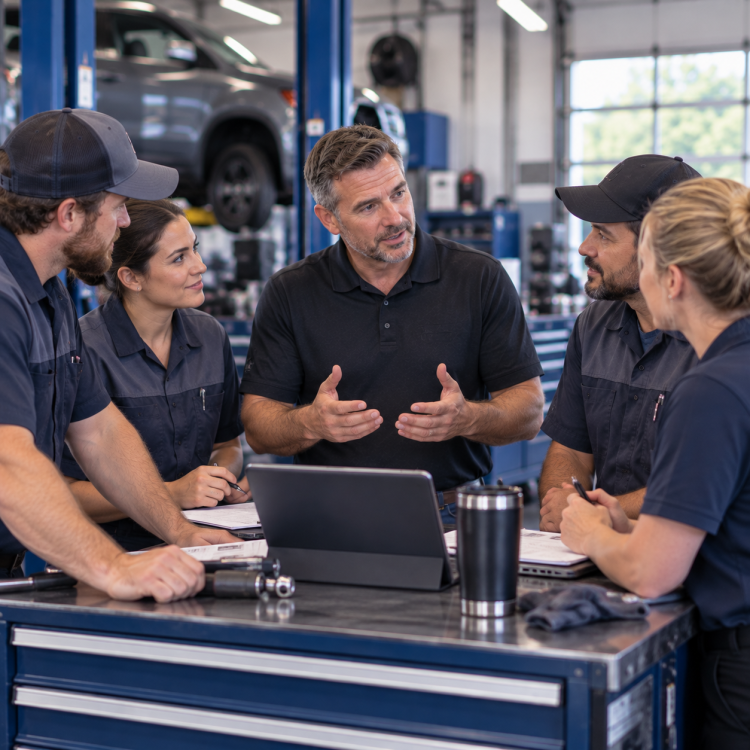
You’re now responsible for helping other people do their work well.
That means setting expectations, communicating clearly, solving problems without taking everything back over, developing employees and knowing when to step in — and when to get out of the way.
Shop owners face the same challenge. Industry examples repeatedly show owners becoming bottlenecks because solving every problem themselves feels faster than teaching someone else how to solve it.
Leadership isn’t about having all the answers. It’s about developing people who don’t always need you to provide them.
Set Clear Expectations
You can’t hold someone accountable for an expectation they never clearly understood.
“Be more productive.”
“Take better care of customers.”
“Follow up more.”
“Take ownership.”
Those statements may sound clear to the person saying them, but they can mean completely different things to different employees.
We’ll work on defining expectations, communicating them clearly and making sure employees understand what successful performance actually looks like.
Clear expectations reduce confusion, frustration and many of the performance problems that managers otherwise end up trying to fix later.
Communicate Before There’s a Problem
Too often, the first serious conversation an employee has with a manager happens when something has gone wrong.
Good leadership requires communication before there’s a problem.
We’ll look at daily communication, team meetings, one-on-one conversations, listening, giving feedback and making sure employees know what’s happening in the business and what’s expected of them.
Regular check-ins can also uncover small problems before they become big ones. Recent shop-management guidance emphasizes consistent meetings and individual conversations as tools for creating alignment and trust.
Hold People Accountable Without Becoming the Bad Guy
Accountability doesn’t have to mean confrontation or punishment.
It means establishing expectations, following up and addressing problems when those expectations aren’t being met.
We’ll help leaders become more comfortable having conversations about performance, behavior, attendance and other workplace issues without avoiding the conversation until they’re angry.
Employees deserve to know when they’re succeeding — and when something needs to change.
Learn to Coach Instead of Always Fixing
Someone walks into your office with a problem.
Do you immediately tell them what to do?
It’s efficient in the moment. But if it happens every day, you’ve unintentionally trained that employee to bring every decision back to you.
We’ll work on asking better questions, coaching employees through problems and helping people develop their own judgment and confidence.
That’s how managers develop stronger employees instead of simply becoming the person everyone depends on.
Delegate Responsibility — and Authority
Delegation is difficult for many shop owners and managers.
You may think, It’ll be faster if I just do it myself.
And today, it probably will be.
But tomorrow you’ll still be doing it.
Effective delegation requires more than handing someone a task. Employees need to understand the expected result, have the tools and authority necessary to accomplish it and know when they should come back to you.
Industry leaders emphasize that delegation works best when expectations, processes, authority and follow-up are all clearly established.
Handle Difficult Conversations
Eventually, every leader has to have conversations they’d rather avoid.
Performance problems. Conflict between employees. Attendance. Attitude. Customer complaints. Disciplinary issues. Sometimes even termination.
Avoiding those conversations rarely makes the problem disappear.
We’ll help managers prepare for difficult conversations, stay focused on facts and behavior, listen to the employee’s perspective, document appropriately and communicate expectations for what happens next.
We’ll also address when an issue moves beyond everyday management and requires professional HR or employment-law guidance.
Build the Culture You Want
Culture isn’t the sign hanging in the break room.
It’s what employees experience every day.
What gets rewarded? What gets ignored? How are mistakes handled? Can employees speak up? Do managers follow the same standards they expect from everyone else?
Leadership behavior establishes those answers.
Strong, consistent leadership is repeatedly identified within the repair industry as fundamental to creating a healthy shop culture.
What We’ll Cover
Leadership & Management Training includes:
- Understanding the difference between leading and doing
- Transitioning from technician or service advisor to manager
- Understanding your role and authority as a manager
- Setting clear expectations
- Communicating effectively with different personalities
- Listening and asking better questions
- Giving constructive feedback
- Coaching employees instead of solving every problem for them
- Delegating responsibility and decision-making
- Building trust without micromanaging
- Creating accountability without creating fear
- Conducting productive team meetings and one-on-ones
- Recognizing and addressing performance problems
- Managing conflict between employees
- Handling difficult conversations
- Performance management and progressive discipline
- Interviewing and hiring fundamentals
- Recognizing when HR or employment-law expertise is needed
- Developing future leaders within the shop
- Creating a positive, accountable workplace culture
- Leading by example
You Don’t Have to Be a “Natural Leader”
Leadership is a skill.
It can be learned, practiced and improved.
And when the people leading your shop become better communicators, coaches and decision-makers, the impact reaches far beyond the manager’s office.
Employees become more confident. Expectations become clearer. Problems get addressed sooner. Owners can delegate more. And the business becomes less dependent on one person having all the answers.
Better leaders build stronger teams. And stronger teams build better shops.
Ready to Develop Stronger Leaders?
Build the practical leadership skills your owners, managers and service advisors need to communicate clearly, develop their people, handle challenges and lead with greater confidence.
EXPLORE THE TRAINING →